Locks and Security News: your weekly locks and security industry newsletter
23rd September 2026 Issue no. 820
Your industry news - first
We strongly recommend viewing Locks and Security News full size in your web browser. Click our masthead above to visit our website version.


Why smart lock installs are quietly breaking locksmith P&Ls
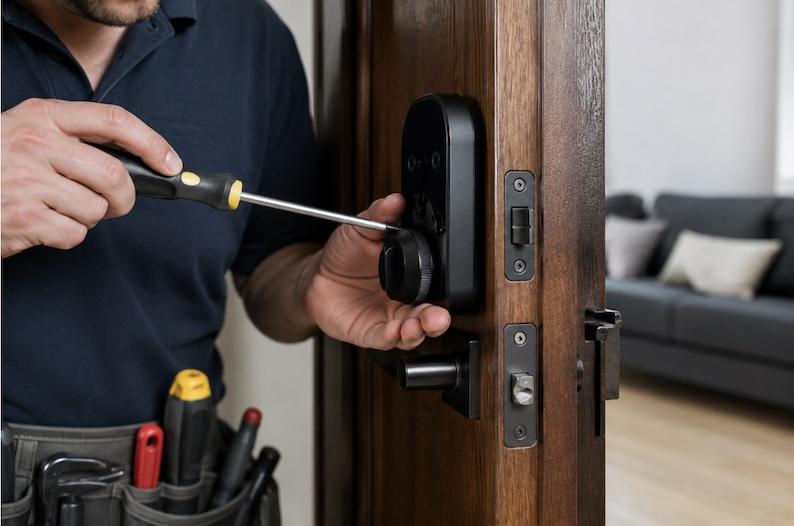 Investigative contributor Bhargavi Halthore writes: A locksmith in Leeds told me last month that his average PVCu smart handle job now runs closer to 90 minutes on site, compared with the 25 to 30 minutes he used to bill for a straightforward Euro cylinder swap. He hadn't changed his call-out price. He'd just quietly absorbed the extra hour, plus a follow-up phone call two days later when the customer couldn't pair the app to a new phone.
That pattern, longer jobs at the same price, with a support tail nobody quoted for, is showing up across the trade. A 2026 UK price guide prices Euro cylinder replacements at 20 to 30 minutes and mortice work closer to 45, while smart lock jobs sit in a materially higher labour bracket. That gap is where margin is disappearing.
The Shape of a Callout Has Changed
For most of the last twenty years, a locksmith callout had a predictable rhythm. Diagnose, quote, fit, test, invoice, leave. The job either fit inside an hour or it didn't, and the pricing structure reflected that reality. Hourly rates for routine work sit at £40 to £100 per hour across the UK, with emergency and out-of-hours at £80 to £200. The maths worked because the time on site was tightly bounded.
Smart hardware has broken that boundary. A 2025 installation guide puts a baseline smart lock fit at 30 to 60 minutes on a door that already has a standard deadbolt, plus 10 to 20 minutes if strike plate or frame alignment is off, plus another 10 to 15 minutes for network setup depending on signal strength. That's before the customer asks how to add their partner's fingerprint. A 2026 product test recorded some deadbolt retrofits at 22 to 28 minutes but flagged one model at 67 minutes because of a failed first attempt and precise fitting requirements. Even experienced testers, working in controlled conditions, are hitting the one-hour mark.
The UK pricing data tells the same story. Lockforce lists smart lock installation labour at £125 to £225, while standard cylinder work sits well below that. A London locksmith prices digital lock fitting from £125 during office hours versus £85 for standard locks. Kingdom Locksmith puts complete smart lock installation at £325 to £520, and a Birmingham price hub gives a typical job duration of 30 minutes to 3 hours for smart lock installs. Three hours. On a call-out ticket that was designed for one.
The industry has already signalled, through its own pricing, that these are different jobs. What most shops haven't done is rebuild their job costing to match.
Where the Hidden Hours Actually Land
When I look at the anatomy of a smart hardware install versus a mechanical one, the extra time doesn't show up in one big block. It's spread across four or five smaller moments that individually feel too minor to bill for, and collectively swallow an hour.
Here's where I keep seeing the hours leak:
Frame and alignment fettling. PVCu doors with multi-point gearing rarely sit clean after ten years. A smart handle that talks to a motorised keep or a Bluetooth cylinder is far less forgiving of drift than a mechanical euro. Fifteen minutes of adjustment that a customer would never see becomes non-negotiable.
Network and pairing setup. Getting a lock onto a home Wi-Fi network, especially on a 5GHz-only router where the lock is 2.4GHz, is a small nightmare. The Aqara U200 and similar Thread-network devices have added measurable time to installs specifically because of protocol setup.
Account creation and app walkthrough. The customer stands next to you while you help them create an account, accept terms, add the device, invite family members, and set up auto-lock schedules. This is training, and it's part of the install now. Nobody's quoted for it.
The "one more thing" trap. They mention their Ring doorbell won't talk to the new lock. They ask if you can look at the camera in the garden. The 2024 to 2033 smart lock market data shows nearly 40 percent of users install smart locks as part of a wider home automation setup, so the "while you're here" ask is now the norm.
The post-install support tail. Two days later: a phone call. Two weeks later: a WhatsApp. Two months later: the batteries died and they don't remember which model it was. These are unbilled minutes that add up to unbilled hours across a customer base.
The mechanical equivalent of all of this is: fit, test, hand over two keys, leave. There is no support tail on a rim cylinder.
What the Job-Costing Data Actually Shows
The bit I want to be careful about: there is no publicly verifiable dataset comparing average labour hours per job between traditional lock work and smart hardware work at the operator level. What we do have, from our own platform analytics, is a view into how shops track this internally when they bother to break it out.
In our customer base, locksmith operators handling automotive lockouts almost universally cite GPS-verified arrival timestamps as their most-used feature when pushing back on chargebacks and disputed service calls. That same instinct, capturing the actual clock time of the job rather than the assumed time, is what shops need to apply to smart hardware installs. If you don't know how long the job really took, you can't quote the next one properly.
From contractors I work with directly in landscape design-build, project profitability swings hardest on labour capture accuracy, and crews that clock in and out by job code rather than by day consistently surface margin issues earlier in the season. That principle transfers almost cleanly to locksmithing. A shop that logs smart hardware jobs under the same code as a cylinder change will never see the pattern. A shop that separates them, and clocks in and out per job, will spot the drift inside a quarter.
The Winchester locksmith cost guide explicitly flags smart locks as jobs that "may require more time" than the 30 to 60 minute standard replacement window. That's a soft statement in a public price guide. The internal version of that statement, if you're running a shop, needs to be a hard number: what is your median smart install time this quarter, and is it moving?
The Support Ticket Problem Nobody's Costing
The install itself is only half of the P&L story. The other half is what happens after you leave the property.
I've talked with installers who've added smart hardware to their mix over the last eighteen months, and the pattern is consistent. For every ten mechanical lock jobs, they get maybe one follow-up call, usually a genuine warranty issue. For every ten smart hardware jobs, they get three to five follow-ups, and the vast majority are not warranty issues. They're:
Customer changed their phone and can't re-pair the lock.
Customer's teenager wants their own PIN and doesn't know how to add it.
Batteries died and the customer doesn't know which type to buy.
Wi-Fi router got replaced and the lock dropped off the network.
Customer bought a second smart device and wants them to "talk to each other."
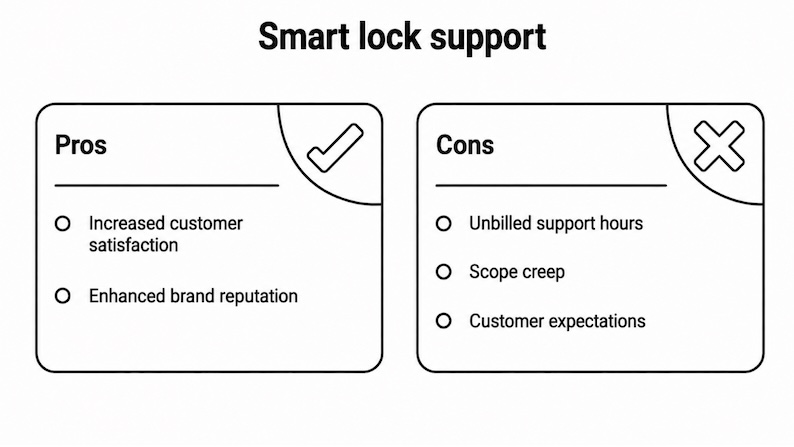
None of that is billable under a standard call-out. The customer feels they paid you to install a working system, and in their mind a working system includes you answering the phone when it stops working. And technically, several of these fall outside the scope of a physical security installer altogether. But if you don't answer, you get a bad review.
UK locksmith hourly rate data is clear that "additional work, such as repairs, key cutting or installation, is charged at the hourly rate on top of the call-out fee." The industry pricing model assumes every extra unit of work is billed. Smart hardware support has quietly created an entire category of work that doesn't get billed at all, because it's happening over the phone, in five-minute increments, and no one has built an invoice line for it.
Turning Support Hours Into Recurring Revenue
The shops I see handling this well have stopped treating smart hardware as a variation of a lock change and started treating it as the entry point to a service relationship. That reframe changes everything about how the job is quoted, delivered, and invoiced.
Here's the structural shift, roughly:
1. Quote the install as a bundled service, not a product fit.
Instead of "fit smart handle: £250," the line item becomes "smart access installation and 30-day activation support: £320." You've added £70 to the quote and given yourself explicit permission to charge for the phone calls in the first month, which you were doing for free anyway. Most customers don't blink. The ones who do aren't your customers.
2. Offer an ongoing support tier.
A modest monthly or annual fee (£8 to £15 a month, or a £75 to £120 annual plan) covers a defined scope: remote troubleshooting, one on-site revisit per year, battery replacement reminders, firmware update checks. This is a familiar model. Alarm and CCTV installers have run maintenance contracts for decades. Locksmiths adding smart hardware are moving into that same product category and need the same commercial model.
3. Capture change orders at the point of scope change.
Most operators report that the gap between estimate and final invoice is where margin quietly disappears, and shops that lock in change orders inside the work order at the moment of scope change recover noticeably more of that lost margin. On a smart install, the moment the customer says "and can you also pair my doorbell" is a change order moment. Get it agreed on the tablet before you touch the second device.
4. Segment the job codes in your back office.
Smart hardware jobs need their own category in your job costing. Mixing them with mechanical lock work will hide the labour drift. Once they're separated, you can see the true median time, the true support tail, and whether your bundled price is actually holding up.
5. Price the emergency variant properly.
Kingdom Locksmith's 2025 rate data puts overnight emergency work at £155 to £230+ per hour. A smart lock that's failed and locked a family out at 11pm is a diagnostic exercise, not a straight 60-minute job. Emergency smart hardware call-outs need their own rate card, separate from the mechanical emergency rate.
What This Looks Like in a Work Order
The practical piece is small but matters. When a smart hardware job starts, the work order should already have the extra scope items visible: network setup, app pairing, customer walkthrough, activation window. When something new comes up on site (the second device, the frame adjustment, the "while you're here"), it goes onto the work order as a change order before the work is done, not scribbled on the invoice afterwards.
This is basic operational hygiene, and it's the difference between a smart hardware line of business that runs at 45 percent gross margin and one that runs at 15 percent because half the labour is invisible. The tools to do this properly, whether that's a job-costing module in your field management platform or a disciplined paper system, matter less than the discipline of doing it consistently. Fence contractors, roofers, HVAC shops, they all hit the same wall when their work got more complex. The ones that survived built job costing that reflected the real work, not the work they wished they were doing.
The Operator Takeaway
If you've added smart hardware to your service mix in the last two years and haven't rebuilt your job costing to match, your P&L is probably lying to you. The lock is the same shape as it was ten years ago. The job is not. Track the real hours, price the support tail explicitly, and stop giving away the second hour of every install for free.
About the Author
Bhargavi Halthore is a content writer at Field Promax, a field service management platform serving trades businesses across the USA and Canada. Connect with her on LinkedIn.
23rd September 2026